




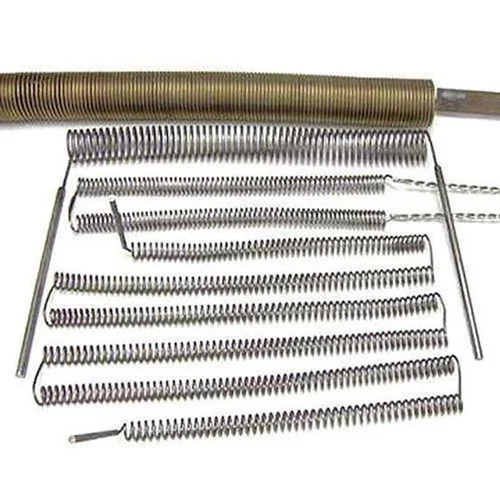

There are two main types of electric resistance alloys. Nickel-chromium (e.g. 80 Ni, 20 Cr) was developed around the turn of the century and was soon used as heating element material in industrial furnaces as well as in electric household appliances.
In the thirties Kanthal introduced a new resistance heating alloy based on iron-chromium-aluminium with a longer life and a higher maximum operating temperature than nickel-chromium.
The two main types of alloys have their own specific properties, with advantages and disadvantages, and are supplied in many different grades and forms. Kanthal manufactures both types of alloys under the names NIKROTHAL (nickel-chromium) and KANTHAL (iron-chromium-aluminium).
In general, KANTHAL is superior to NIKROTHAL in respect of performance and life and is therefore nowadays a standard material choice when it comes to metallic heating elements for industrial furnaces. The most important advantages are:
- Higher maximum element temperature of 1425°C (2600°F) compared to 1250°C (2280°F)
- Longer life (2–4 times)
- Higher surface load
- Higher resistivity
- Lower density
- No spalling oxide, which may contaminate the goods and the furnace and also cause short circuit or failure of elements and gas burners.
For the furnace user, using KANTHAL results in less material at a lower price and also – a longer life. Table 1 shows an example ofweight saving – and lower cost – obtained byusing KANTHAL instead of nickel-chromiumalloys. This lower element weight will alsoresult in considerable cost savings in the support system, because fewer suspensionhooks are necessary.
The NIKROTHAL alloy may have specialadvantages if you need a heating elementhaving very good mechanical properties in thehot state. KANTHAL APM has, however, creepstrength at elevated temperatures in the samelevel as NiCr 80/20.
Table 1. A 120 kW furnace equipped with R.O.B. elements. 3 elements of 40 kW each, 380 V.
| Element Data | NiCr 80/20 | KANTHAL A1 |
|---|---|---|
| Furnace temperature, °C °F | 1000 1850 | 1250 2282 |
| Hot resistance, Rw | 3.61 | 3.61 |
| Temperature factor, Ct | 1.05 | 1.06 |
| Cold resistance, R20 | 3.44 | 3.41 |
| Wire diameter, mm in | 5.5 0.217 | 5.5 0.217 |
| Surface load, W/cm2 ,W/in2 | 3.9 , 19.9 | 3.98 , 25.7 |
| Wire length, m, ft (3 elements) | 224.9 738 | 174.6 573 |
| Wire weight, kg, lb (3 elements) | 44.4 98 | 29.6 65 |
| Weight Saving- | 44.4-29.6 | 33% | 98-65 | 33% |
| 44.4 | 98 |